Last Updated: October 30, 2026
Quick Summary
Find local musicians for your restaurant through online musician directories and marketplaces, musicians’ unions, music schools, and local networks, then vet each act by listening to at least two recordings before you book. Match the act to your room and occasion, and confirm licensing, noise limits and pay in writing before the first gig.
- Online musician directories let you filter performers by genre, instrument and area.
- Music schools, universities and orchestras are full of students and tutors who gig.
- Listen to at least two recordings or a live clip before booking any act.
- For dinner service, plan around two sets with a break between them.
- Confirm live music is authorised on your premises licence and note any conditions.
Table of Contents
- Where to Find Local Musicians: Directories, Unions and Venues
- Choosing the Right Act for Your Restaurant
- Vetting Musicians: Recordings, Profiles and Auditions
- How Much to Pay a Musician for a Gig
- Restaurant Live Music Set Length and Equipment
- Licensing, Noise and Compliance for Live Music
- Your Restaurant Musician Booking Enquiry Template
- Planning Your First Live Music Night at Plonkers
- Frequently Asked Questions
Where to Find Local Musicians: Directories, Unions and Venues
Finding the right musician for your restaurant starts with knowing where to look. The best local musicians rarely come from a single source.
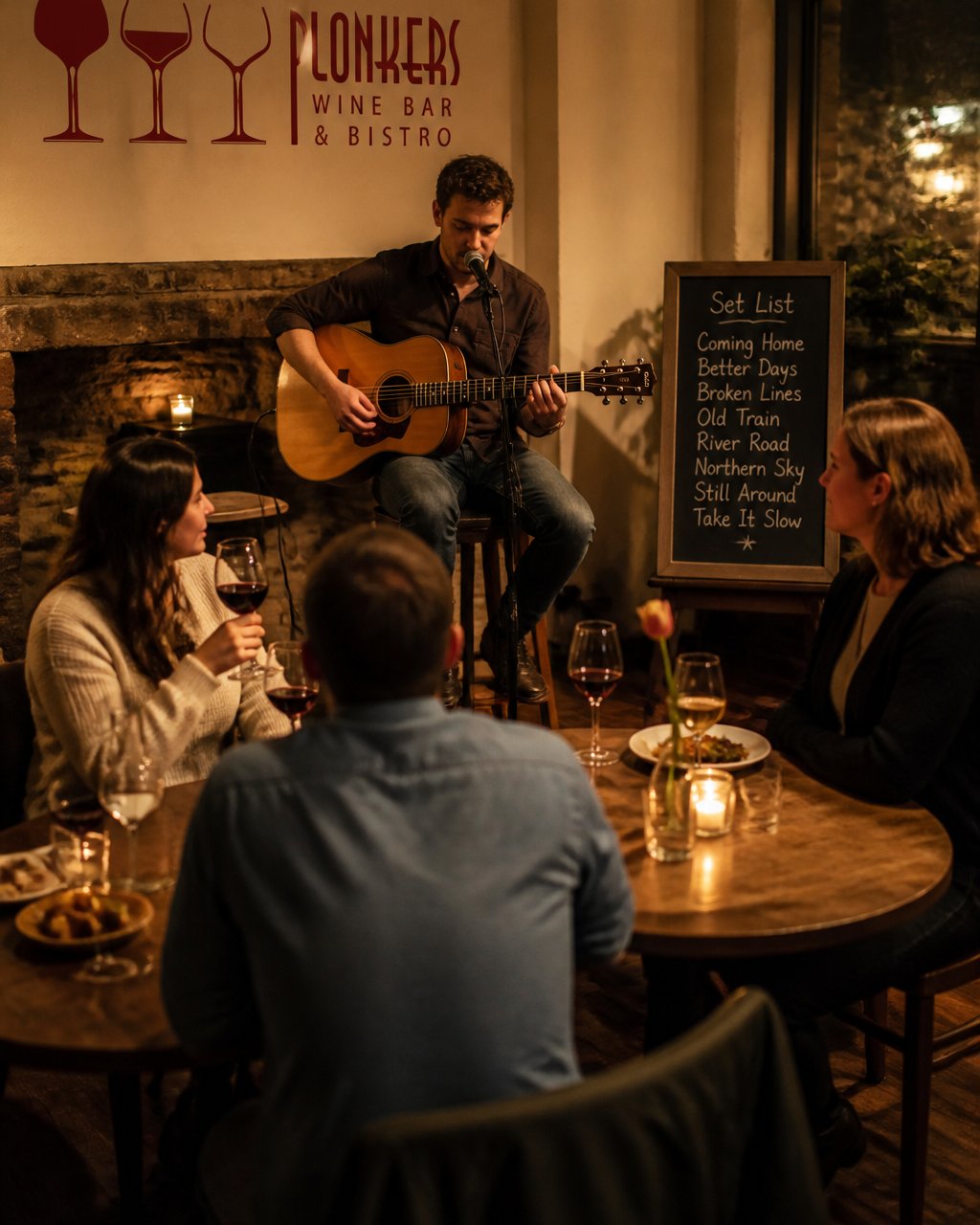
Finding the right musician takes a little legwork, but the payoff is a room full of people who came for the music and stayed for dinner.
Below, we break down the practical routes to find local musicians for restaurants, from online platforms to the unions and music schools that connect you with reliable acts.
Online musician directories and marketplaces
Online platforms are the fastest place to start. A musician directory is a website where performers list profiles, recordings, and contact details so venues can search and filter by genre, instrument, and area.
Here is where to look:
- Musician marketplaces: Sites that let you post a “musicians wanted” ad or browse artist profiles by city and style.
- Streaming and portfolio sites: SoundCloud and Bandcamp pages give you a quick listen before you make contact.
- Social media: Local community groups and pages often surface acts who play nearby.
Use the search and filter tools to narrow by genre, instrument, and availability. Save the profiles that fit, then reach out with a clear brief.
Musicians’ unions, music schools and local networks
The personal route can be just as useful as online platforms. Music schools, universities, and orchestras are full of talented students and tutors who may be interested in live gigs.
Try these:
- Contact the music department at a local university or college.
- Ask a music school for tutors or advanced students who perform.
- Post in community groups and local networks.
- Visit venues that host live music and talk to the acts directly.
These routes take more effort.
Choosing the Right Act for Your Restaurant
The right act for a restaurant is the one that fits your room, your menu, and your crowd. A loud function band suits a party night. It will ruin a quiet dinner service.
Match the act to the occasion:
- Solo performer or duo: Best for background acoustic music during dinner.
- Jazz or classical trio: Suits a wine bar or a slower evening.
- Local bands: Better for weekend nights when energy matters more than conversation.
Think about capacity, seating, and the audience you want to attract. A small riverside room with 40 covers needs a different act from a 130-seat function space. Get this match right and the whole night works.
Match the act to the room and the occasion, because the wrong fit can ruin a service.
| Act type | Best for |
|---|---|
| Solo performer or duo | Background acoustic music during dinner |
| Jazz or classical trio | Wine bar or a slower evening |
| Local bands | Weekend nights when energy matters more than conversation |
Vetting Musicians: Recordings, Profiles and Auditions
Vetting is how you avoid a bad first night. A musician profile and a couple of recordings tell you more than any email. Listen before you book.
Work through this checklist:
- Listen to at least two recordings or a live clip.
- Check their artist portfolio and past gigs.
- Confirm the instrument and genre match your brief.
- Ask for references from other venues.
- Offer a short paid audition or a low-risk first slot.
Auditions matter for bigger bookings. A 20-minute trial in your actual room shows you how they sound and how they handle a crowd. It also shows whether their setup fits your space.
How Much to Pay a Musician for a Gig
Pay is the part of booking that causes the most friction, so it pays to go in with clear expectations. Fees depend on the act’s experience, the length of the set, the day of the week and the type of slot, so there is no single rate. Always confirm the figure in writing before the gig.
Deposits, cancellation and payment timing
A clear payment structure protects both sides:
- Deposit: Agree with the act whether a deposit secures the date, and how much it is, before the booking is confirmed.
- Balance: State in the agreement when and how the balance is paid.
- Cancellation: Agree a notice period and the terms that apply if either side cancels late, and put them in writing.
- Travel: Agree whether travel is included or added. For acts coming from further out, a mileage or flat travel contribution is normal.
- Equipment: Confirm who provides the PA, microphones, and lighting.
Set the terms before the first note
Put the fee, set length, breaks, deposit, cancellation window, and payment method in a short written agreement, even an email exchange is enough. Clear terms set expectations for both sides. Treat payment as part of your booking workflow, not an afterthought.
Ask each act for their rate and whether it changes by day of week. Comparing a few quotes against the same brief helps you judge whether a fee suits your room and slot.
Restaurant Live Music Set Length and Equipment
The right set length keeps the room comfortable. For a dinner service, a common approach is to plan around two sets with a break between, giving diners time to talk, order, and enjoy the food without the music taking over.
Equipment is where small venues often stumble. Keep it simple: How to Set Up Sound Equipment in Small Venues.
- Ask what the act brings and what they need from you.
- Confirm power points, space, and access to the performance area.
- Set a sound level that lets diners talk.
- Have a backup plan if the act’s gear fails.
Licensing, Noise and Compliance for Live Music
Live music in a licensed venue sits inside a framework of premises licensing, noise control, and safety rules. Getting this right before you book protects your licence and keeps the night running smoothly. Compliance establishes the foundation for a professional atmosphere, yet the success of the performance ultimately depends on choosing live music that aligns with the specific mood and scale of your venue.
Premises licence and live music
Your premises licence is the starting point. Check:
- Whether live music is authorised: Confirm that your licence permits live music, and read any conditions attached to it, for example, permitted hours, maximum capacity during performances, or a requirement for door staff.
- Any conditions on the licence: Conditions may limit the number of performers, the type of music, or the times music can be played. A condition that says ‘recorded music only’ means you need a variation before booking a band.
- Variation if needed: If live music is not covered, you can apply to the licensing authority to vary the licence. Allow time for this, it is not a same-week fix.
- Late-night rules: If performances run past the point where late-night refreshment or alcohol conditions apply, check how the music interacts with those hours.
Noise, neighbours and sound limits
Noise is the most common source of complaints and the most common reason a live music night gets shut down early.
- Set a sound level: Agree a practical limit with the act before the night, one that lets diners talk without raising their voices. A sound-level meter is a cheap way to keep everyone honest.
- Consider the room: Hard surfaces, low ceilings, and open windows all push sound outward. Position the act away from shared walls and open doors.
- Neighbour impact: If you have residential neighbours, a short note before the first night and a firm finish time go a long way. Most councils treat repeated noise complaints seriously.
- Finish times: Set a hard finish time that fits both your licence and the neighbourhood, and stick to it.
Safety and capacity
- Capacity: Keep the performance area within your licensed capacity, including performers and their equipment.
- Fire safety: Keep exits and escape routes clear, and check that any added equipment does not block them (Protecting Your Escape Routes).
- Electrical safety: Confirm that any PA or lighting you provide is PAT tested and that cables are routed safely.
Do not assume a licence condition is flexible because ‘everyone does it’. A breach can lead to a review of your premises licence, which is far more costly than checking first. Confirm the detail with your local council’s licensing authority before the first booking.
A short compliance checklist before you book
- Confirm live music is authorised on your premises licence and note any conditions.
- Check permitted hours and any late-night rules.
- Agree a sound limit and a hard finish time with the act.
- Confirm capacity for performers and equipment.
- Check fire exits and electrical safety for any added gear.
- Keep a record of the checks and any council correspondence.
Your Restaurant Musician Booking Enquiry Template
A clear enquiry saves time for you and the musician. Use this template to make first contact. Fill in the blanks and send it by email or message.
Subject: Live music enquiry for [venue name]
Hi [musician name],
I am [your name] from [venue name], a [type of venue] in [area].
Keep it short, specific, and easy to reply to. The clearer your brief, the better the acts you attract.
Planning Your First Live Music Night at Plonkers
The best way to learn is to run one night and refine from there. Start small, keep the brief tight, and build from a single successful evening.
Here is how we would plan a first night:
- Pick a date and a set length that fits your service.
- Book one act you have vetted and heard.
- Confirm licensing, noise, and equipment needs.
- Promote the night to your regulars and local community groups.
- Run the night, note what worked, and book the next one.
At Plonkers Wine Bar, live music and open mic nights are part of who we are. We are family owned and run, completely independent, and proud to support local breweries and drinks makers.
If you are planning your own live music night, or you just want a warm room with proper music and a well-poured drink, come and see how we do it.
Frequently Asked Questions
How do you choose the right musician or band for a restaurant?
Match the act to your room and your regulars. A 40-cover bistro suits a solo performer or acoustic duo, while a larger space can carry a three or four-piece band. Listen to recordings before you commit, check the act has played similar venues, and confirm they can keep volume conversational. Ask for a repertoire list so you know the genre fits the night you are planning, and always see them live or watch a full video before booking.
How much should a restaurant pay a musician for a live performance?
Fees vary with the act’s experience, the length of the set and the day of the week, so there is no single going rate. Solo performers usually cost less than a full band. Agree the fee in writing before the gig, state whether food and drinks are included, and confirm how and when payment is made. Ask the musician directly for a quote rather than guessing.
How long should a live music set be in a restaurant?
Restaurant gigs are often run as two or three sets with breaks in between, giving diners time to talk and staff time to serve. A single continuous set works for a short early-evening slot, but it tires the performer and leaves no room for a break. Build the schedule around your service times so the loudest part of the set does not land on your busiest sitting.
What should a restaurant include in a musician booking enquiry?
State the venue and location, the date and times you need, and the type of act you are looking for. Include your budget range, whether equipment and a PA are provided, and how long each set should be. Mention any licensing or volume limits, and ask for recordings, a repertoire list and references. Close with a clear request for availability and a quote so the musician can reply in one message.
