
Table of Contents
- York Christmas Market Dates 2026: When to Plan Your Visit
- York Christmas Market Opening Times and Weekly Closure
- York Christmas Market Entry Fee: What It Actually Costs
- York Christmas Market Stalls: Chalets, Crafts and Seasonal Food
- Getting There: Transport, Parking and Arrival Planning
- Crowd Levels, Best Times to Visit and Accessibility
- Budget, Weather and What to Bring
- Conclusion
- Frequently Asked Questions
Last Updated: October 21, 2026
York Christmas Market Dates 2026: When to Plan Your Visit
The York Christmas Market returns in mid-November 2026 and runs daily through late December, giving you roughly six weeks to plan around it. This guide from Plonkers Wine Bar covers the dates, opening hours, costs and practical logistics so your visit runs smoothly rather than turning into a shuffle through crowds.
The York Christmas Market is a seasonal outdoor market held across York city centre each winter, with wooden chalets selling crafts, gifts and seasonal food and drink. The 2026 edition follows the established pattern: it opens in mid-November and closes in the days before Christmas, running seven days a week throughout.
For exact confirmed dates, check the official Visit York events calendar before booking travel, as the opening and closing days are confirmed closer to the season. Plan your trip for a weekday in late November or early December if you want the stalls without the crush.
Book accommodation and any restaurant table before you book trains. Market weekends in December fill York’s city centre venues first, and the riverside spots go earliest.
York Christmas Market Opening Times and Weekly Closure
Stalls generally open mid-morning, around 10.30am, and trade until early evening, typically 5pm to 7pm, with Sundays and Christmas Eve finishing earlier. The market operates seven days a week across its roughly six-week run, but individual chalets are independent businesses: some close on a Monday or Tuesday to restock, so a specific maker you have travelled for may not be trading every day. If one stall is the reason for your trip, check the Visit York events calendar or the trader’s social media before you set out.
Crowd levels by day and time, the practical detail most guides skip:
- Quietest window: Tuesday to Thursday, 10.30am to noon. You get the crafts stalls before coach parties arrive and can move freely along Parliament Street.
- Busiest window: Saturdays and Sundays from about 11am to 4pm, and any day in the final week before Christmas. Expect shoulder-to-shoulder conditions on Parliament Street and slow movement through St Sampson’s Square.
- Best compromise: a weekday in late November or the first week of December, arriving at opening and leaving by early afternoon.
- Evening trade: limited. This is a daytime market, not a night market, so the atmosphere peaks between late morning and mid-afternoon when the chalets are fully staffed and daylight is best.
If you are building a full day around the market, arrive for opening, browse the crafts first, and book lunch for around 12.30pm, by the time you sit down, the street outside will be at its fullest. Families with young children should aim for the morning slot; by late afternoon the crowds and cold combine to shorten tempers. Wheelchair users and pushchair users will find the flat pedestrian streets manageable early, but the same streets become difficult to navigate once the midday rush builds.
If you want the market at its most photogenic without the crush, aim for a weekday morning in the first week of December, the lights are on, the chalets are open, and you can actually stop to look at the stalls.
York Christmas Market Entry Fee: What It Actually Costs
There is no entry fee. York Christmas Market is free to walk through, and you only spend money on what you buy from the stalls. That makes it one of the better-value festive days out for families, since a browse costs nothing and you can set your own budget.
Where costs creep up is everything around the market: parking, a hot drink or two, food, and any gifts you spot. Bring cash for the smaller craft stalls, though most traders now take card. Set a rough budget before you go and treat the food and drink as part of the day out rather than an afterthought.
For a proper meal rather than a stall snack, our Christmas menu at Plonkers Wine Bar is available for prebooking only from mid-November, which suits couples through to full work Christmas parties.
York Christmas Market Stalls: Chalets, Crafts and Seasonal Food
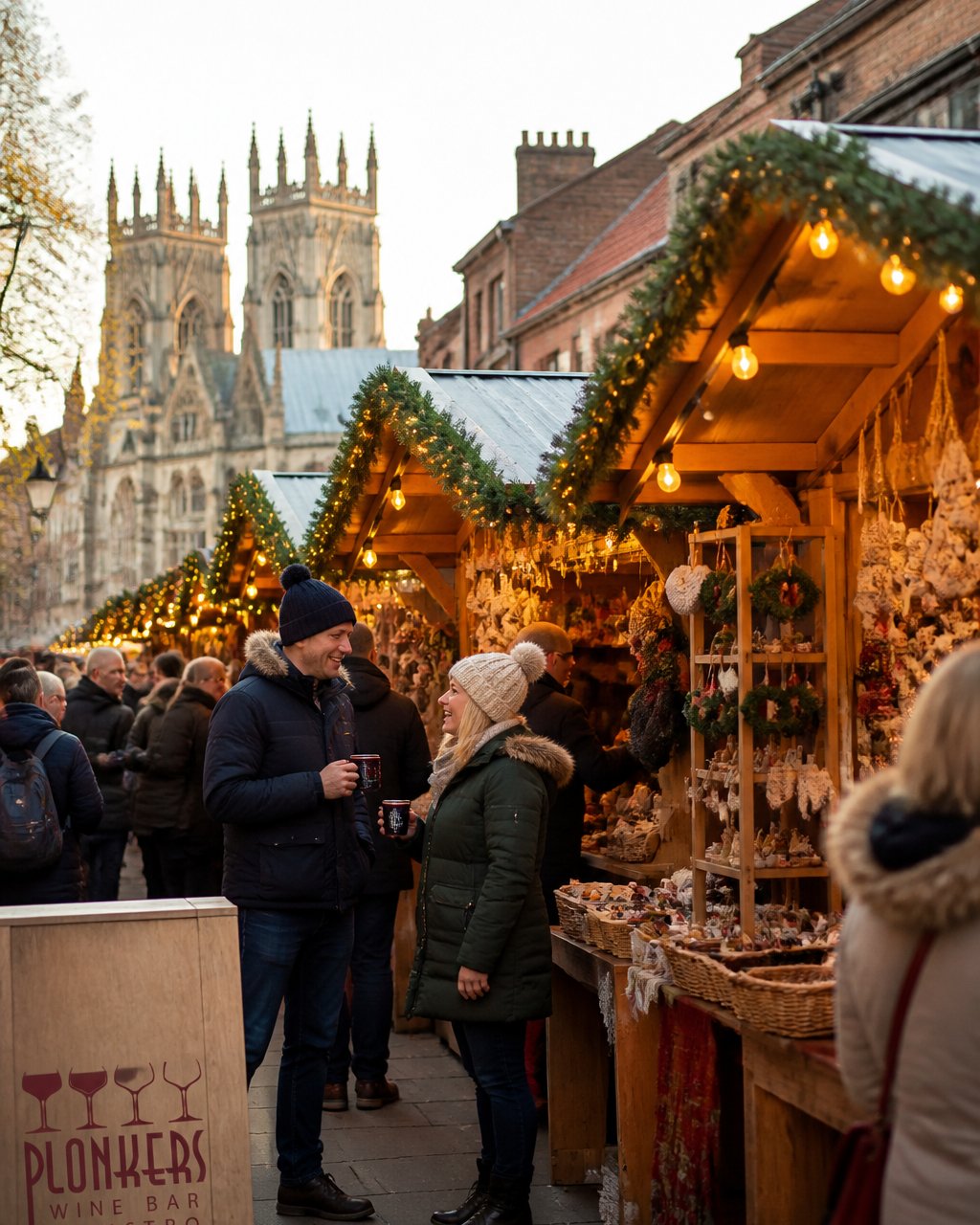
The market spreads across Parliament Street and St Sampson’s Square, with wooden alpine chalets selling local crafts, unique gifts and seasonal food and drink. The chalets are the heart of it: timber cabins dressed with festive lights, arranged along the historic streets so the market sits inside the city rather than in a field outside it.
What you will find, broadly:
- Local crafts and unique gifts: ceramics, textiles, jewellery and woodwork from regional makers
- Seasonal food and drink: mulled wine, hot chocolate, bratwurst, mince pies and roasted nuts
- Christmas shopping: decorations, cards and small gifts you will not find on a high street
The Shambles Market runs alongside the seasonal stalls, so you can browse both in one loop. Go for the crafts early; the food queues build fastest from midday.
Getting There: Transport, Parking and Arrival Planning
Trains are the sensible option. York station sits a short walk from the city centre, and the market is inside the pedestrian core, so you avoid parking entirely. If you drive, use the park-and-ride services on the edge of the city rather than hunting for central spaces, which are limited and expensive during the festive season.
Buses run frequently into the city centre from the outer districts. Once you are in, everything is walkable: Parliament Street, St Sampson’s Square and the Shambles sit within minutes of each other.
Do not drive into the city centre expecting to park near the stalls in December. The closest car parks fill by mid-morning on weekends, and you will spend more time circling than shopping.
Crowd Levels, Best Times to Visit and Accessibility
Weekday mornings are the quietest window, and weekends after 11am are the busiest. If you want the festive atmosphere without the squeeze, aim for a Tuesday to Thursday visit in late November or the first week of December.
Accessibility is good in principle because the market sits on mostly flat pedestrian streets, but the crowds themselves are the real obstacle. Wheelchair users and families with pushchairs should go early, when there is room to move. The historic streets are cobbled in places, so sturdy footwear matters for everyone.
For families, the daytime hours suit young children best. By late afternoon the crowds and the cold combine to shorten tempers.
Budget, Weather and What to Bring
Budget planning, the market is free to enter, so your spend is entirely optional, but a realistic day out adds up. As a rough guide for planning (prices vary by stall):
- Hot drinks: mulled wine or hot chocolate typically £4-£6 per mug, with a refundable deposit on some reusable cups.
- Street food: bratwurst, crepes or similar stall food usually £6-£10 per portion.
- Gifts and crafts: small ceramics, decorations or cards from around £5; larger textiles or jewellery can run £20-£60 or more.
- Travel: a return train fare varies by origin; park-and-ride is typically a few pounds per vehicle including passengers.
Most traders now take card, but a small amount of cash is useful for the occasional stall that does not. Set a rough budget before you go and treat food and drink as part of the day rather than an afterthought, it is easy to spend £30-£50 per person without buying a single gift.
Weather and what to bring. December is cold, often wet, and dark by mid-afternoon. Bring a waterproof coat with a hood rather than an umbrella, umbrellas are impractical in crowded streets. Layers matter more than one heavy coat, because you will move between cold outdoor stalls and warm shops. Sturdy, comfortable shoes are essential: the historic streets are cobbled in places and wet cobbles are slippery. Gloves and a hat make browsing far more pleasant, and a reusable cup or small bag for purchases saves juggling.
Do not underestimate the cold. Standing still at stalls in December feels far colder than walking, and the market is entirely outdoors. If you feel the chill, step inside a nearby shop or café to thaw out before continuing.
If the weather turns, that is your cue to step inside somewhere warm. Our riverside bar has been family-run since the early 1980s, serves home-cooked food from locally sourced ingredients, and pours specialist beers, wines and spirits from independent makers. It is a short walk from the market and a good place to thaw out before the train home.
Conclusion
The market is free, central and easy to reach, but the difference between a lovely day and a frustrating one comes down to timing and planning. Go early, go midweek, dress for the cold and book your meal ahead.
At Plonkers Wine Bar, we offer a warm riverside stop with home-cooked food, an independent drinks list and a Christmas menu for prebooked groups from mid-November. Book now and make the market day finish somewhere worth sitting down.
Frequently Asked Questions
Is York Christmas Market worth going to?
For most visitors, yes. The market fills the city centre with wooden chalets selling local crafts, seasonal food and drink, and the historic streets add a backdrop you won’t get at a purpose-built site. It suits a half-day visit rather than a full day, especially if you pair it with the city’s attractions. Weekday mornings are calmer than weekends, and booking a table for lunch or dinner in advance takes the stress out of a busy December day.
Is York Christmas Market free to enter?
Yes. There is no entry fee to walk around York Christmas Market. You only pay for what you buy from the stalls, food vendors and nearby shops and venues. Budget for drinks, snacks and gifts rather than a ticket, and carry a card as most traders accept contactless payments. Some individual attractions nearby charge admission, so check ahead if you plan to combine the market with a museum or tour.
What time is best to go to York Christmas Market?
Weekday mornings from opening until around midday are the quietest. Weekends and late afternoons get very busy, particularly in December, and narrow historic streets slow to a crawl when crowds build. If you want photographs and space to browse the chalets, arrive early. If you prefer atmosphere and festive lights, come after dusk but expect queues at popular food and drink stalls.
How long should you spend at York Christmas Market?
Most visitors spend two to three hours browsing the stalls, stopping for food and drink, and walking between the market areas. Add extra time if you plan to visit nearby attractions, do Christmas shopping in the city centre, or book a meal. A relaxed half day gives you room to explore without rushing, and booking lunch or an early dinner in advance means you aren’t hunting for a table when the crowds peak.