
Table of Contents
- Why Choose Independent Restaurants Over Chains: The Real Differences
- How Locally Sourced Ingredients Change What’s on Your Plate
- The Benefits of Eating Local Go Beyond the Menu
- A Unique Restaurant Atmosphere You Won’t Find in a Chain
- Independent Restaurants and the Local Economy
- What Independent Dining Costs and What You Get for It
- How to Choose the Right Independent Restaurant
- Conclusion: Making the Choice That Fits Your Table
- Frequently Asked Questions
Last Updated: October 3, 2026
Why Choose Independent Restaurants Over Chains: The Real Differences
Choosing an independent restaurant over a chain means trading predictability for food with a traceable source, a kitchen that answers to its own name, and money that stays in the neighbourhood. This guide from Plonkers Wine Bar examines the practical differences between the two models, from ingredient sourcing to atmosphere to what you actually pay for.
The Chain Model vs the Independent Kitchen
A chain restaurant is a business built on replication: the same menu, the same portion sizes, the same suppliers, in every location.
That single structural difference drives almost everything else. Chains buy centralised, cook to a specification, and staff to a script. Independents buy locally, cook to taste, and staff to their own standards.
The trade-off is real. A chain gives you the same dish you had last time, in a different town. An independent gives you a dish that exists because of where you are.
How Locally Sourced Ingredients Change What’s on Your Plate
Locally sourced ingredients mean shorter journeys from producer to kitchen, which usually means fresher food and a menu that shifts with the seasons. You can often trace exactly where the meat, fish, or vegetables came from, and the kitchen can tell you.
Shorter Supply Chains, Fresher Food
A chain’s supply chain is designed for volume and consistency. Ingredients travel through central distribution, which adds days between harvest and plate. That system works, but it exists to guarantee uniformity, not freshness.
An independent kitchen buying from nearby suppliers works on a tighter loop. Delivery is more frequent, quantities are smaller, and the kitchen can adapt when something is at its best.
For anyone researching food provenance and sustainability guidance, the practical takeaway is straightforward: the shorter the supply chain, the easier it is to know what you are eating.
The Benefits of Eating Local Go Beyond the Menu
The benefits of eating local stretch past your plate: stronger local suppliers, lower transport impact, and a menu that reflects what is genuinely in season rather than what ships well. When you eat at an independent, you are funding a shorter, more transparent food chain.
Seasonality is the clearest example. A kitchen tied to local sourcing cooks around what is available now, not what can be frozen and shipped year-round. That changes how food tastes and how it is prepared.
Ask your server what came in that morning. A kitchen that buys locally usually knows, and the answer tells you more about the food than any menu description.
A Unique Restaurant Atmosphere You Won’t Find in a Chain
A unique restaurant atmosphere comes from a building with a past and staff who know the regulars. Chains are designed to feel identical everywhere; independents are shaped by the space they occupy and the people who run them.
Character, History, and the Third Place
Sociologists use the term third place for the informal social spaces that sit between home and work: the pub, the café, the neighbourhood bistro.
Chain outlets rarely become third places. They are built for throughput, not lingering. Independents, especially family-run ones, tend to accumulate the history that makes a room feel lived-in.
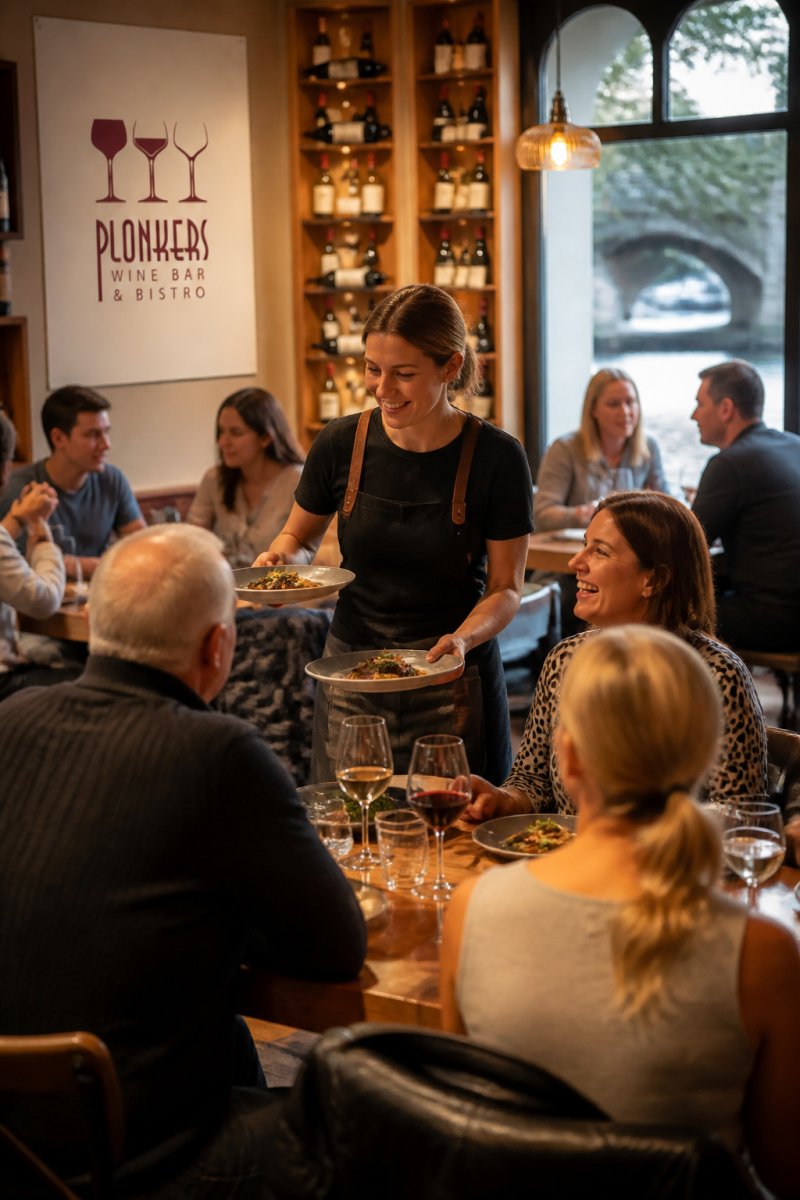
Plonkers Wine Bar has occupied its riverside building since the early 1980s, and you can feel that history in the room.
Independent Restaurants and the Local Economy
Money spent at an independent restaurant tends to recirculate locally: wages to local staff, orders to nearby suppliers, and custom to other small businesses nearby. This is the economic multiplier effect, and it is one of the strongest arguments for choosing independent, but it is worth understanding the mechanism rather than just repeating the phrase. This cycle of investment strengthens the community fabric by prioritizing the artisanal production of locally baked bread over mass-produced alternatives that rely on distant industrial supply chains.
How the Multiplier Actually Works
When you spend £30 on a meal, the destination of that money differs sharply between the two models.
At a chain, a large share of the till goes to head office as royalty or management fees, to a central purchasing function, and eventually to shareholders or a parent company that may be registered elsewhere. Some of it stays local as wages, but the profit element leaves the area.
At an independent, the same £30 is more likely to be split between:
- Local wages paid to staff who live in the area and spend in the same high street
- Local suppliers, butchers, greengrocers, bakers, breweries, who in turn employ local people
- Local services, electricians, plumbers, accountants, cleaners, printers
- Rates and utilities paid to local authorities and regional providers
- The owner’s own household spending, which usually happens in the same town
Each of those recipients then spends a portion of what they received, and a portion of that stays local again.
Why This Matters on the High Street
A common pattern in town-centre economics is that a high street with a healthy mix of independents retains more spending power than one dominated by chain outlets.
This is why local authorities and business improvement districts often treat independent hospitality as infrastructure rather than just commerce.
| What You’re Comparing | Independent Restaurant | Chain Restaurant |
|---|---|---|
| Sourcing | Often local and seasonal | Centralised distribution |
| Menu | Changes with supply | Fixed specification |
| Pricing | Varies; reflects ingredient cost | Standardised |
| Atmosphere | Shaped by the building and staff | Designed for consistency |
| Money flow | Recirculates locally | Returns to head office |
| Best for | Occasions, discovery, community | Speed, familiarity, low risk |
That table is the honest version of the comparison. Chains win on predictability. Independents win on everything that makes a meal memorable, and on where the money ends up.
If you want your spending to do more than one job, an independent is the more efficient choice for the local economy. The meal is the visible product; the recirculation is the invisible one.
What Independent Dining Costs and What You Get for It
Independent dining often costs more than a chain meal, and the extra usually goes into ingredients, staff time, and the cost of running a single site without bulk buying power. What you get back is food cooked to order, a menu that changes, and a room with some character.
Where the Price Difference Comes From
The overhead costs of a single-site kitchen are higher per cover than a chain’s, because there is no central purchasing to spread the load. That is the structural reason behind the price gap, not greed. The main drivers are:
- Ingredient cost per unit, a chain buying 10,000 kg of chicken negotiates a lower price than a kitchen buying 20 kg
- Labour per cover, a chain can standardise prep across sites; an independent preps each dish in one kitchen
- Energy and rent per cover, a single site carries the full fixed cost across fewer covers
- Waste, a seasonal menu reduces waste in theory, but a slow Tuesday still costs the same to open
- Compliance and admin, food safety, licensing, allergen management and payroll all cost the same whether you serve 40 or 400 covers a day
None of these are inefficiencies to be eliminated. They are the price of cooking to order, in one place, for people you might see again.
Nutritional Transparency: A Gap the Chains Cannot Easily Close
One area where independents often outperform chains is dietary and nutritional transparency. A large chain must manage allergens across hundreds of sites and thousands of staff, so it tends toward rigid, standardised protocols: fixed recipes, pre-printed allergen matrices, and limited flexibility.
An independent kitchen, by contrast, usually has one chef or a small team who know every ingredient in every dish. That makes it easier to:
- Adapt a dish for a specific allergy rather than simply removing it from the menu
- Explain what is in a sauce, a stock, or a garnish without consulting a central database
- Offer a genuinely generous vegan or gluten-free option rather than a token one
- Tell you whether a dish was cooked in the same oil or on the same grill
This is not a guarantee, an independent can be careless, and a chain can be excellent, but the structural advantage sits with the smaller kitchen.
At Plonkers Wine Bar, we price around what the kitchen actually buys that week, which is why the menu is not identical all year.
Do not judge an independent purely on price per plate. Compare what is on the plate: sourcing, portion, and whether the kitchen cooked it or reheated it. That is where the money went.
How to Choose the Right Independent Restaurant
Choosing well comes down to a handful of checks you can run before you book.
- Check whether the menu changes with the seasons, a sign of real sourcing
- Look for named suppliers or producers on the menu
- Read recent reviews for consistency, not just the highest rating
- Confirm they can handle your dietary requirements before you book
- Ask about capacity if you are booking for a group
- Check whether live music or events run regularly, if that matters to you
- Look at the building itself: independents often occupy spaces a chain would not
For a group booking, capacity matters more than atmosphere. Plonkers Wine Bar hosts everything from couples to full work Christmas parties, and our Christmas menu opens for prebooking from mid-November.
If you are heading to the Grand Opera House, our pre-theatre offering is built around a fixed start time.
For broader context on how independent venues shape local high streets, British Hospitality Association industry research is worth reading.
Conclusion: Making the Choice That Fits Your Table
The honest answer is that chains and independents solve different problems. If you want the same meal you had last time, a chain delivers that reliably.
At Plonkers Wine Bar, we have run our riverside bistro as a family business since the early 1980s, untied to any supplier or chain. We cook from locally sourced meat, fish, and vegetables, pour many specialist beers, wines, and spirits, and host regular live music and open mic nights.
If that sounds like your kind of table, book now and see the difference for yourself.
Frequently Asked Questions
What is the difference between a chain restaurant and an independent restaurant?
A chain restaurant is one of many outlets owned by the same company, following a standardized menu, branding, and supply chain across every site. An independent restaurant is owned and run by individuals or a family, often with just one location. That means the menu changes with the seasons, the kitchen can adapt dishes to your preferences, and the person cooking may well be the person who owns the place.
How does dining at an independent restaurant support the local economy?
Independent restaurants tend to buy from nearby suppliers, butchers, greengrocers, and breweries, so more of the money you spend stays in the local area. They also employ local staff and often hire tradespeople, cleaners, and musicians from the community. This creates an economic multiplier effect where one evening out supports several local businesses rather than sending profit to a distant head office.
Why do independent restaurants often have better quality ingredients?
Independent kitchens usually work with shorter supply chains. They can buy small batches from local farms, adjust their menu based on what is fresh that week, and cook dishes from scratch rather than reheating pre-prepared components. This means locally sourced ingredients arrive fresher, and the kitchen has more freedom to change a dish if the produce is particularly good.
How does the atmosphere differ between independent venues and national chains?
Chains are designed for consistency, so their interiors, lighting, and music are largely identical from one site to the next. Independent venues reflect the personality of their owners and their building. You might find original features, local artwork, live music nights, or a riverside terrace. Many regulars treat their favourite independent as a ‘third place’ alongside home and work, somewhere to relax and feel recognised.
Do independent restaurants offer more creative menus than chains?
They often do, because they are not bound to a fixed corporate menu. Independent chefs can experiment with seasonal specials, accommodate dietary requirements like vegan or gluten-free dishes without a fuss, and change the menu when an ingredient is at its best. Chains rely on predictability and bulk purchasing, which limits how much a single kitchen can improvise.