Last Updated: November 4, 2026
Quick Summary
A live entertainment budget for a small bistro should list every cost layer, not just the performer fee. Those layers include sound hire, PPL and PRS music licences, extra staff hours and lost covers. Split costs into fixed and variable groups, cap spending at a set share of takings, and review each night’s return.
- Treat live entertainment as an operating cost, not an extra expense.
- Count performer fee, sound hire, licensing, staff hours, lost covers and marketing.
- Split costs into fixed items like licences and variable items like performer fees.
- Confirm PPL and PRS licence needs before confirming any booking.
- Calculate ROI as net gain divided by total cost, tracked against a four-week baseline.
Table of Contents
- What Live Entertainment Really Costs a Small Bistro
- Step 1: Set Your Venue Capacity and Floor Space Limits
- Step 2: Allocate Your Entertainment Budget Against Fixed and Variable Costs
- Step 3: Work Out PPL PRS Music Licence Costs Before You Book
- Step 4: Negotiate Performer Fees and Hire Local Musicians
- Step 5: Calculate ROI on Restaurant Events and Equipment Upkeep
- Booking Your First Monthly Live Music Budget at Plonkers
- Frequently Asked Questions
What Live Entertainment Really Costs a Small Bistro
Live entertainment can make or break a small bistro’s evening trade. Yet many owners book music on instinct and only work out the true cost once the invoices arrive. A clear live entertainment budget for a small bistro protects your margins and still lets the room come alive.
The honest answer is that costs stack up in layers. The performer’s fee is only the first one. Sound hire, licensing, insurance, extra staff hours and lost table turns all add to the total. Start by listing every layer so nothing surprises you later.
- Performer or band fee
- Sound equipment hire or upkeep
- Music licensing (PPL and PRS)
- Extra staff hours for setup and service
- Lost covers if the room feels too full or too loud
- Marketing spend to promote the night
Treat live entertainment as an operating cost, not an extra. That mindset makes it far easier to judge whether a night actually pays its way.
Step 1: Set Your Venue Capacity and Floor Space Limits
Before you set a budget, work out how many people your room can hold comfortably with live music. Capacity drives revenue, and revenue decides what you can afford to spend on the performance.
Measure the floor space that a performer needs. A solo acoustic act needs a corner and a power point. A duo or trio needs more room, plus space for the diners to move around them.
Next, check how many covers you can serve on a typical night. If a live act takes up four tables, you lose those seats for the evening. Work out what that lost revenue costs you per night.
Watch out: A room that feels packed can cut your spend per head. Some guests leave early when the noise climbs. Keep the performance area small and the sound level modest.
Step 2: Allocate Your Entertainment Budget Against Fixed and Variable Costs
Split your costs into two groups. Fixed costs stay the same whether the room is full or empty. Variable costs rise and fall with the number of nights and guests.
Fixed costs usually include:
- Annual music licences
- Sound equipment maintenance and depreciation
- Insurance cover for the performance area
- Regular performer retainers, if you have them
Variable costs usually include:
- Performer fees per booking
- Extra staff hours on event nights
- Promotion for each event
- Consumables such as extra glassware or cleaning
A common approach is to cap entertainment spend at a set share of monthly food and drink takings. Many owners aim for a modest percentage, then adjust based on how each night performs. The right share depends on your margins, so test it over a few months rather than copying a figure from elsewhere.
Always keep a contingency fund for surprise costs such as a broken speaker or a last-minute replacement act.
Step 3: Work Out PPL PRS Music Licence Costs Before You Book
Playing recorded or performed music in a business usually requires licences (Get a licence to play live or recorded music). In the United Kingdom, PPL and PRS for Music are the main bodies to check (Get a licence to play live or recorded music). PPL licenses the recording rights, while PRS for Music covers the composition rights.
Work out these costs before you confirm any booking. Licence fees depend on your premises type, opening hours and the nature of the music played. Contact both organisations directly for current quotes, since the figures change over time.
Some owners forget that a licence is needed even when the music is live. Confirm with each body whether your setup is covered, and keep the paperwork on file for inspections.
- Check PPL licence requirements for your venue
- Check PRS for Music requirements for live performances
- Add the annual licence cost to your fixed costs
- Review the terms each year as your event schedule changes
Step 4: Negotiate Performer Fees and Hire Local Musicians
Performer fees vary widely, and many acts will negotiate for a regular booking. Ask for a fixed rate for a series of dates rather than paying a full fee every time. A set monthly slot often costs less per night than one-off bookings, because the musician values the certainty and saves on marketing. Performer pricing depends on the type of act, the length of the set and the number of dates booked.
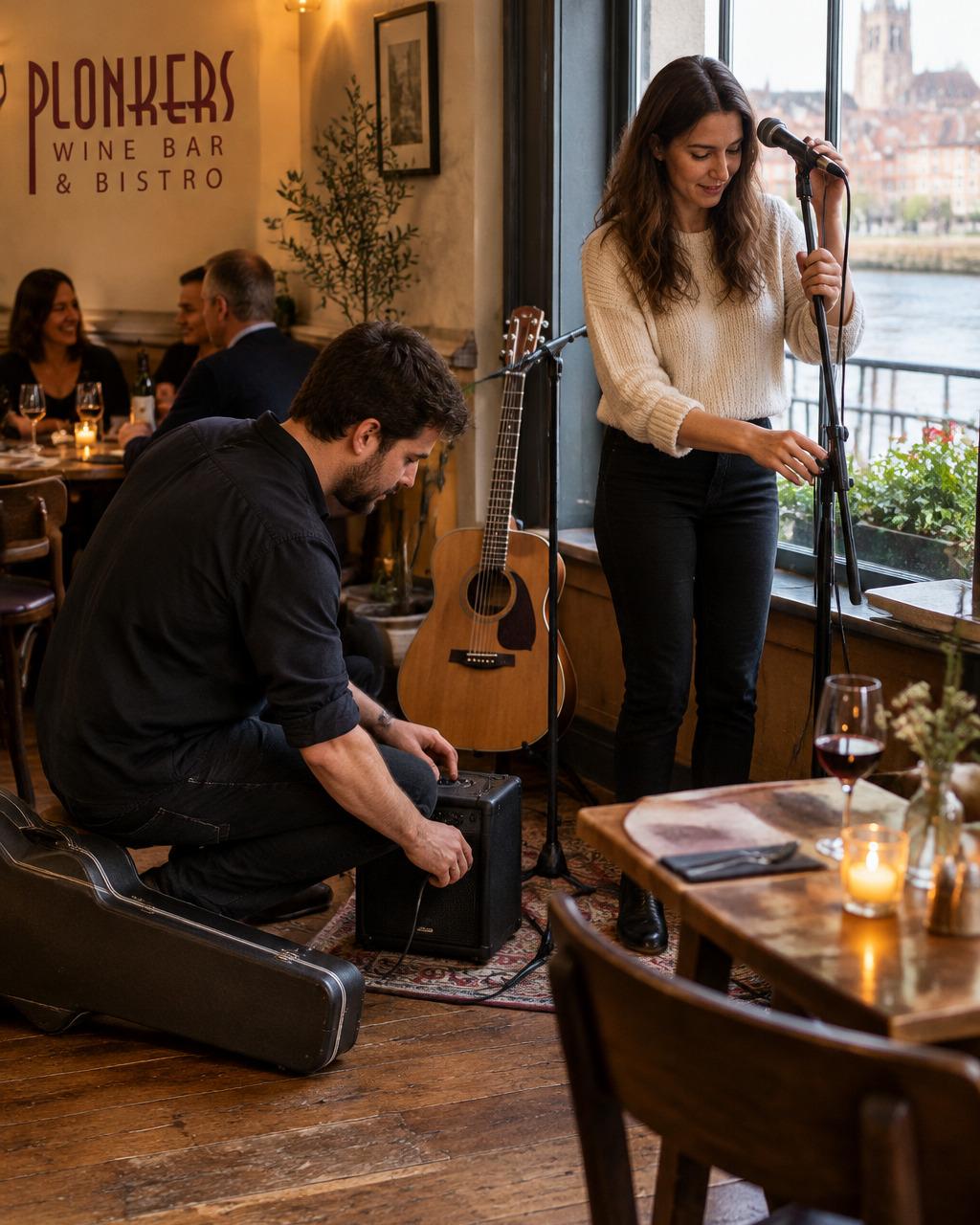
Local musicians are often a sensible choice for small bistros. They usually bring a loyal following and charge less than touring acts, and they are far easier to rebook at short notice. Look for acoustic duos, jazz trios and open mic performers who suit a relaxed dining room.
When you negotiate, be clear about the set length, the sound needs and the times. A written agreement protects both sides. Agree on whether the fee covers travel, equipment and any sound checks, and state who supplies the PA. If the act brings its own gear, the fee is usually higher but your maintenance burden is lower; if you supply the house system, factor its wear into the price you are willing to pay.
Two overheads sit behind every booking and are routinely left out of the negotiation. The first is music licensing. In the United Kingdom, playing live or recorded music in a business generally requires licences from PPL, which covers the recording rights, and PRS for Music, which covers the composition rights.
Many bistros also let performers keep a share of any tips. This keeps the fee lower while giving the musician a reason to play well, and it costs you nothing beyond the till reconciliation.
Here is a simple negotiation checklist:
- Agree the set length and start time
- Confirm the fee and whether it includes equipment
- Confirm who supplies the PA and who maintains it
- Agree a cancellation policy in writing
- Set a fixed monthly slot if the act is regular
- Confirm the sound requirements for the room
- Check PPL and PRS for Music cover before the first booking
- Confirm public liability insurance covers the performance area
Watch out: a cheap act that needs a full PA, a sound check and two extra staff hours can cost more in total than a slightly dearer act that arrives with its own compact rig. Price the whole night, not just the fee.
Step 5: Calculate ROI on Restaurant Events and Equipment Upkeep
To judge whether live entertainment is worth it, calculate the return on each event. The basic formula is simple. Subtract the total cost of the night from the extra revenue it brings in, then divide the result by the total cost. A more accurate return calculation starts with a complete cost estimate, so budgeting for event rentals should be part of the same planning process as fees, staffing, and expected sales.
The hard part is not the arithmetic. It is isolating the revenue that the performer actually caused. Most bistros simply compare the event night’s takings with a normal Tuesday and call the difference uplift. That overstates the result, because a promoted night also pulls in regulars who would have eaten anyway.
A common pattern among small operators is that drink sales rise more than food sales on music nights, because guests linger over a second bottle rather than ordering another course. That matters for your budget: if the performer lifts wet sales by 15 per cent but leaves food flat, the night can still pay for itself provided your drink margin is healthy.
Equipment is the part most owners forget. A house sound system represents a capital cost. Spread that cost across its useful life rather than treating it as a one-off, and set aside a maintenance reserve each year for cables, stands and repairs so an unexpected failure does not derail your budget.
Scheduling also affects sustainability. Weekly events may build a loyal crowd, but they can strain your budget and exhaust a small pool of local acts. Monthly or fortnightly nights often balance cost and impact better for a small bistro. Choose the frequency your budget can hold over the long term, and review the ROI of each slot after three months before committing to more dates.
Watch out: an event that looks profitable on total takings can still lose money once you charge the lost covers from tables removed for the performance area and the extra staff hours. Include both in the cost line, or the ROI figure flatters the night.
The article’s ROI method comes down to a few figures you can track for each event:
| Item | Value | Note |
|---|---|---|
| Basic ROI formula | Net gain ÷ total cost | Subtract event cost from extra revenue first |
| Worked example | £450 cost, £720 revenue | Net gain of £270 |
| Loss threshold | Below zero | Night lost money regardless of music quality |
| Covers to track | Total covers | Compare with a four-week baseline |
| Spend to track | Average spend per head | Also split food and drink |
| Baseline period | Four weeks | Same night of the week |
| Review point | Three months | Reassess ROI before booking more dates |
Booking Your First Monthly Live Music Budget at Plonkers
Start small. Pick one night each month, set a clear budget, and track the results. At Plonkers Wine Bar, we find that a steady monthly rhythm builds a loyal audience without stretching the books. You can see what live music venues in York already offer for ideas on format and pricing before you commit.
If you plan a bigger evening with a group, it helps to reserve a table for a larger group early so the entertainment and seating can be arranged together.
Review each event after it happens, then adjust your fixed and variable costs. Over time, your live entertainment budget becomes a tool for growth rather than a guess.
Frequently Asked Questions
How much should a small bistro budget for live music per night?
There is no fixed figure, because the cost depends on the number of performers, the length of the set, and whether the musicians are paid a fee or take a share of door or bar income. A practical method is to start from your target monthly entertainment spend, divide it by the number of nights you plan to host music, and check that the per-night figure still leaves room for your food and drink margin. Pricing for performers varies, so ask local musicians for quotes for the set length and format you need, and compare them against your own numbers rather than an industry average.
Do I need a PPL PRS licence for live music in my bistro?
In the United Kingdom, playing recorded or live music in a commercial premises usually requires a PPL PRS music licence, because it covers the rights holders of the music being performed. Covers, cover bands and acoustic sets all fall under the same general rule, and the licence fee depends on your premises type and capacity. Check the current tariff directly with PPL PRS, as fees change, and include the figure in your monthly entertainment budget before you confirm any bookings.
How do I calculate the return on investment for live entertainment?
Take the extra gross profit that entertainment nights generate, compared with equivalent quiet nights, then subtract the total entertainment cost for those nights, including the performer fee, licence share, sound equipment upkeep and any marketing spend. Divide the net gain by the total cost to get a percentage return. Track covers, average spend and bar sales on music nights for at least three months, because a single busy night can give a misleading result.
How can I find affordable local musicians for my bistro?
Start with local open mic nights, music colleges and community music groups, which often have performers willing to play for a set fee or a share of the takings. Agree the set length, the fee and the equipment provided in writing before the first booking, and build a short list of reliable acts you can rebook. Consistent bookings usually bring better rates than one-off gigs.
