
Table of Contents
- Why Locally Sourced Ingredients Belong on Every Bistro Menu
- The Benefits of Locally Sourced Food for Restaurants
- Seasonal Ingredients for Bistro Menus: Planning Around Supply Variability
- The Environmental Benefits of Eating Locally Grown Food
- How Restaurants Source Local Ingredients: A Practical Guide
- Costs, Margins, and Measuring the Return on Local Sourcing
- Common Mistakes When Bistros Go Local (And How to Avoid Them)
- Conclusion: Making Local Sourcing Work for Your Bistro
- Frequently Asked Questions
Last Updated: October 12, 2026
Why Locally Sourced Ingredients Belong on Every Bistro Menu
Locally sourced ingredients are grown, reared, or produced within a short distance of the kitchen that serves them, typically the same county or region. For a bistro, that proximity changes how the food tastes, how the menu evolves through the year, and how the business connects to its community.
The benefits run deeper than freshness: they shape menu planning, cut food miles, keep money in the local economy, and give a restaurant a story no chain can copy.
Local sourcing is not a marketing badge. It is an operating decision that affects your menu structure, your supplier relationships, and your margins. Get the sourcing right and everything else follows.
The Benefits of Locally Sourced Food for Restaurants
The clearest benefit of locally sourced food for restaurants is quality you can taste and defend. Produce picked at peak ripeness and delivered within hours retains more flavour, texture, and nutrition than food that has spent days in transit.
Beyond taste, local sourcing delivers practical advantages:
- Food quality and freshness: Shorter supply chains mean less time between harvest and service.
- Menu differentiation: A menu built around local farms and producers is hard for competitors to replicate.
- Customer appeal and loyalty: Diners increasingly want to know where their food comes from and who grew it.
The UK government guidance on food provenance and labelling sets out how food businesses should describe origin claims, which matters when you tell customers an ingredient is local.
Seasonal Ingredients for Bistro Menus: Planning Around Supply Variability
Seasonal ingredients are at their natural peak in a given month or season, and planning around them keeps a local menu affordable and exciting. The catch is variability: a wet spring or early frost can shift what is available week to week.
Building a Menu That Flexes With the Harvest
Design a menu with built-in flexibility rather than a fixed list of dishes. Build each dish around a core technique or base, then swap the produce as the harvest changes, a seasonal salad can move from spring leaves to summer tomatoes to autumn roots without rewriting the menu.
We plan our specials board around what local growers actually have that week, which keeps the kitchen responsive and gives regulars a reason to return.
The Environmental Benefits of Eating Locally Grown Food
The environmental benefits of eating locally grown food centre on food miles, the distance food travels from farm to plate. Shorter supply chains generally mean fewer transport emissions, less packaging, and less refrigeration energy.
There are caveats worth understanding. The WRAP guidance on food waste and sustainability highlights that reducing food waste often delivers a bigger environmental gain than transport alone, which is why portion planning and using whole ingredients matter as much as sourcing.
Sustainable sourcing also supports biodiversity when farms rotate crops and maintain hedgerows and field margins. Buy local where it genuinely reduces waste and transport, and do not treat proximity as the only measure of environmental impact.
How Restaurants Source Local Ingredients: A Practical Guide
How restaurants source local ingredients comes down to building direct relationships with growers, butchers, fishmongers, and producers, then verifying their claims. Start with farmers’ markets, local food hubs, and regional producer groups, and ask other independent venues who they buy from.
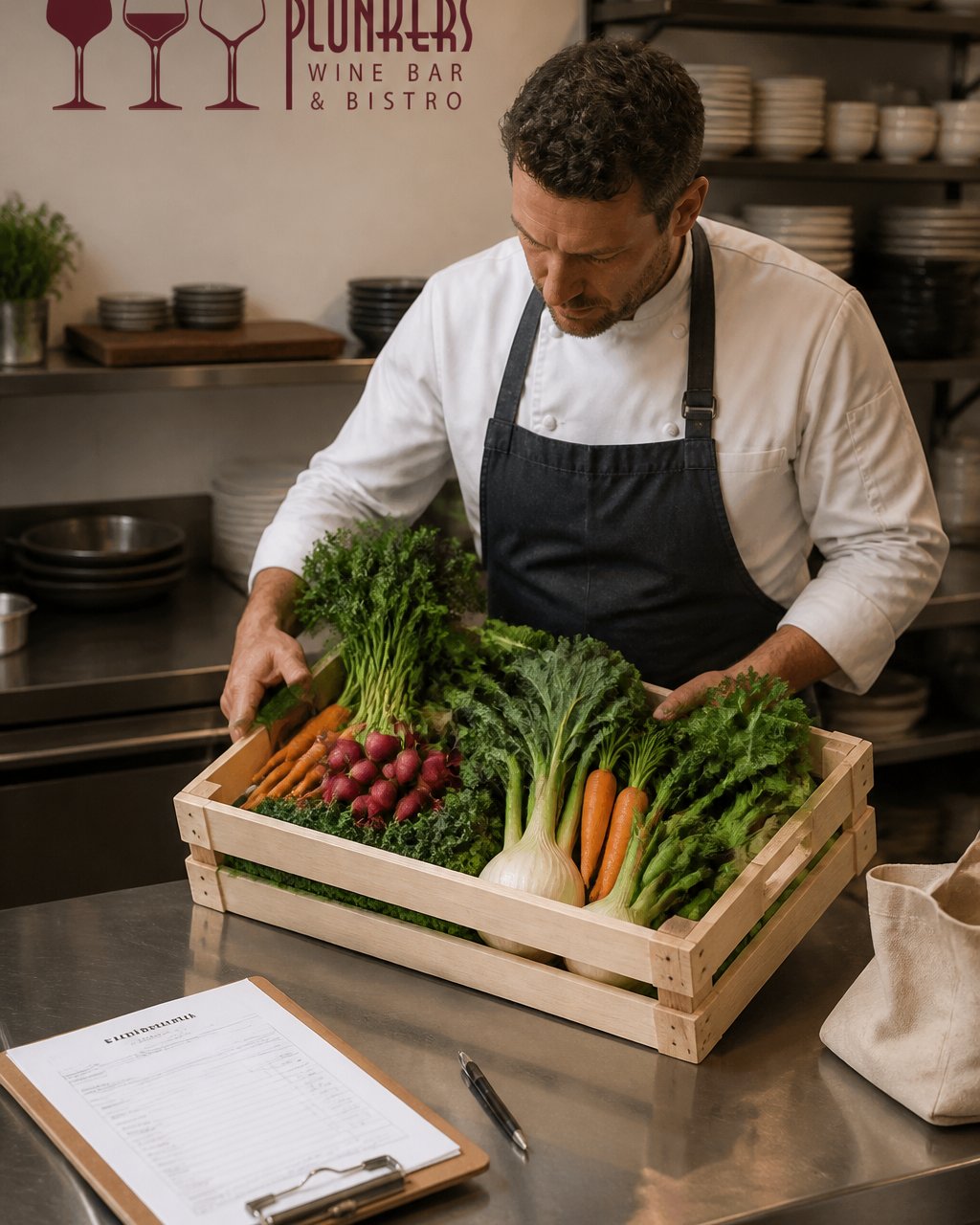
A practical sourcing sequence looks like this:
- Map what you actually need. List your highest-volume ingredients first. A bistro running 60 covers a night gains more from switching potatoes, onions, and salad leaves than from a single luxury garnish.
- Find producers within your region. Visit markets, join local food networks, and ask for introductions. County producer groups and regional food hubs are the fastest route to growers who already supply hospitality.
- Trial small before committing. Order a sample, cook with it, and check consistency across a few deliveries.
- Agree terms in writing. Confirm volumes, delivery days, lead times, and how shortages are handled. Verbal agreements collapse the first time a harvest fails.
- Review regularly. Reassess quality, reliability, and cost every season, and drop suppliers who cannot hold standards.
Vetting Suppliers and Verifying Provenance Claims
Verifying provenance means checking that a supplier’s origin claims hold up, not simply taking them at face value. Ask where the produce is grown, request documentation where relevant, and visit the farm or production site when you can. The Food Standards Agency guidance for food businesses explains the traceability and labelling obligations that apply to food sold to the public, which is a useful benchmark for any supplier conversation.
A workable vetting checklist for a bistro looks like this:
- Traceability: Can the supplier name the farm, field, or producer for each line? If not, treat the claim as unverified.
- Food safety and hygiene: Ask about refrigeration in transit, delivery vehicle standards, and food business registration. Cross-check the Food Standards Agency’s hygiene rating scheme where they sell direct to the public.
- Delivery reliability: Confirm delivery days, cut-off times, and what happens when an order is short.
Defining ‘Local’ Honestly
There is no single legal definition of ‘local’ for food in the UK, which is why vague claims are risky. A common working definition is food produced within a set radius, often 30 to 50 miles, or the same county or region.
A useful rule of thumb is to distinguish between:
- Grown or reared locally: the primary ingredient comes from within your defined radius.
- Produced locally: the ingredient is made locally, even if some inputs are not.
- Assembled locally: the dish is finished in your kitchen but the ingredients may come from further afield.
Only the first two should carry a ‘local’ claim on the menu. The third is a preparation claim, not a sourcing one.
The most common mistake is claiming an ingredient is local when only part of it, or only the final assembly, happens nearby. If a supplier cannot tell you exactly where an ingredient was grown or reared, do not put the claim on your menu.
Building Backup and Contingency
Even the best local supply chain will fail at some point, a wet spring, late frost, or a supplier’s illness can wipe out a key ingredient for a week. Plan for it:
- Keep a short list of regional alternatives for your highest-risk ingredients, so you are not scrambling on the day.
- Hold a small non-local fallback for staples you cannot run out of, and be honest on the menu about where they come from.
- Design dishes with substitutable components so a missing ingredient changes the dish rather than removing it.
A bistro that manages its local supply chain well treats it like any other critical supplier relationship: documented, reviewed, and never dependent on a single point of failure.
Costs, Margins, and Measuring the Return on Local Sourcing
Local sourcing does not automatically cost more, but it requires deliberate margin management. Small producers often cannot match bulk wholesale pricing, so unit costs can be higher. Reduced waste, stronger loyalty, and the ability to charge fairly for food with a clear story offset that.
The mistake most bistros make is comparing headline prices rather than landed costs. A cheaper wholesale box with 15% spoilage, or one that forces you to over-buy, can cost more per usable portion than a pricier local delivery that arrives fresh and in the right quantity.
Comparing Landed Costs, Not Sticker Prices
Landed cost is what an ingredient actually costs once delivery, spoilage, prep waste, and storage losses are counted. To compare a local supplier against a wholesaler fairly:
- Work out usable yield. If a 10 kg box of local carrots yields 9 kg after trimming and a 10 kg wholesale box yields 7.5 kg, the local box is cheaper per usable kilo even at a higher headline price.
- Add delivery and minimum order effects. A £40 local minimum may push you to over-order; free wholesale delivery may charge more per unit. Factor both in.
- Account for spoilage. Track how much of each delivery is discarded. Local produce often lasts longer, reducing effective cost.
- Include storage. Short shelf life means more deliveries and staff time; long shelf life means more fridge space and energy.
A simple weekly exercise is to pick your five highest-volume ingredients and compare their landed cost per usable portion across suppliers. Most operators find the gap is smaller than the headline prices suggest, and sometimes runs the other way.
Managing Waste as a Margin Lever
Waste is where local sourcing either pays off or quietly bleeds margin. Whole, seasonal, locally grown produce arrives less processed, which means more trim, but also more chances to use it well.
Practical waste controls for a bistro:
- Cook to a prep list, not a guess. Base daily prep on covers booked plus a realistic walk-in allowance.
- Use trim deliberately. Vegetable offcuts go into stocks, soups, or pickles; bones and carcasses into sauces.
- Run a daily specials board around what needs using first, not what looks most profitable on paper.
WRAP guidance on food waste and sustainability is a useful reference for reducing avoidable waste in a commercial kitchen.
Pricing Dishes Around Local Ingredients
Pricing a local dish is not simply cost-plus. Local ingredients carry a story premium, but that only translates into price if the dish is described well. A few principles:
- Price to the menu, not the ingredient. If a local ingredient pushes cost above the price band customers expect, adjust the portion, garnish, or cut rather than breaking the band.
- Protect your gross margin target. Most bistros work to a food cost in the high twenties to low thirties; local sourcing should not push a dish above that without a clear reason.
- Use local ingredients where they earn their place. A local heritage tomato in a simple salad justifies a premium; a local onion in a base sauce does not.
Measuring the Return
Track a small set of numbers to see whether local sourcing pays off:
| What to Measure | How to Track It | What Good Looks Like |
|---|---|---|
| Food cost percentage | Weekly ingredient spend vs. sales | Stable or falling over a season |
| Landed cost per usable portion | Supplier invoice ÷ usable yield | Falling or holding against alternatives |
| Food waste | Weekly waste log by ingredient | Fewer discarded items over time |
| Menu item performance | Sales mix per dish | Local dishes selling steadily |
| Customer feedback | Reviews and repeat visits | Positive comments on quality and provenance |
Pricing any specific dish depends on availability, season, and portion size, so review menu costs regularly. The goal is a menu where local sourcing strengthens the offer without squeezing the margin to nothing.
Local sourcing is a margin decision as much as a sourcing one. Compare landed costs, control waste, and price dishes to your menu band, then let the numbers, not the marketing, decide how far to take it.
Common Mistakes When Bistros Go Local (And How to Avoid Them)
The biggest mistake bistros make is treating local sourcing as a label rather than a practice. If the food does not taste better or arrive fresher, customers notice the gap between the claim and the plate.
Other frequent errors:
- Overcommitting to one supplier. If a single farm has a bad season, your menu suffers. Spread your risk.
- Ignoring seasonality. Offering the same dishes year-round forces out-of-season buying, undermining the point.
- Forgetting to tell the story. Diners want to know which farm grew their vegetables. Name suppliers on the menu where you can.
Do not assume local always means better without checking quality. Vet every supplier the same way, and let the food speak for itself.
Conclusion: Making Local Sourcing Work for Your Bistro
Building a menu around local, seasonal ingredients takes real work: finding producers, planning around the harvest, and managing margins. Done well, it gives your bistro better-tasting food, a story worth telling, and a stronger community connection.
Frequently Asked Questions
How can diners tell whether a restaurant genuinely uses locally sourced ingredients?
Ask staff directly which farms or producers supply the kitchen, and look for named suppliers on the menu rather than vague phrases like ‘fresh local produce’. Menus that change with the seasons are a strong signal, as are daily specials built around what is available that week. Some bistros list their suppliers on a chalkboard or website. If a restaurant cannot name a single producer, the claim is probably marketing rather than practice.
What are the environmental benefits of eating locally grown food?
Shorter supply chains mean fewer food miles, which reduces the carbon footprint of transporting ingredients. Local sourcing also supports biodiversity when farms grow a wider variety of crops suited to the area, rather than monocultures. It can cut packaging and refrigeration needs too, since produce travels shorter distances and arrives fresher. That said, transport is only one part of food’s environmental impact, so how something is grown matters as much as how far it travels.
Does buying local food always mean it is more sustainable?
No. A locally grown crop produced in a heated greenhouse or with intensive inputs can carry a higher environmental cost than something grown outdoors and shipped a moderate distance. The same applies to meat and dairy, where farming method matters more than mileage. Local sourcing works best as part of a broader approach that also considers seasonality, production methods, and how much food is wasted in the kitchen.
How do seasonal ingredients for bistro menus affect food costs and consistency?
Seasonal ingredients are usually cheaper when they are at their peak, because supply is abundant and transport needs are lower. The trade-off is availability: a dish built around one crop may need to come off the menu when the harvest ends. Bistros handle this by keeping a core menu of year-round staples and rotating specials around what is fresh. That approach protects margins while keeping the menu interesting for regular diners.
Plonkers Wine Bar has been sourcing locally for decades, and it shapes everything from our seasonal specials to our vegan options and our Christmas menu. If you are looking for a riverside bistro with home-cooked food, an independent drinks list, and regular live music, we would love to welcome you. Get started with Plonkers Wine Bar and book your table for a meal that celebrates the best of what local producers grow.