Table of Contents
- What to Expect at a Brewery Tasting
- Craft Beer Tasting Experience Benefits: What You Actually Gain
- Best Craft Beer Styles for Beginners
- How to Judge Whether a Tasting Is Worth the Money
- Red Flags to Avoid When Booking a Tasting Session
- Home Tasting vs Professional Tour: Which Suits You?
- Frequently Asked Questions
Last Updated: September 11, 2026
What to Expect at a Brewery Tasting
A local craft beer tasting is a guided or self-directed session where you sample small measures of different beers, usually in a taproom or brewery, to compare aroma, flavour, and mouthfeel side by side. Whether it is worth it depends on what you want: education, a social activity, or simply a good drink.
A well-run tasting gives you a curated selection you would never assemble yourself, plus someone to explain why each beer tastes the way it does. A poor one gives you four thimbles of lukewarm ale and a bill you resent. The difference is the format, not the beer.
The Typical Structure of a Guided Tasting Session
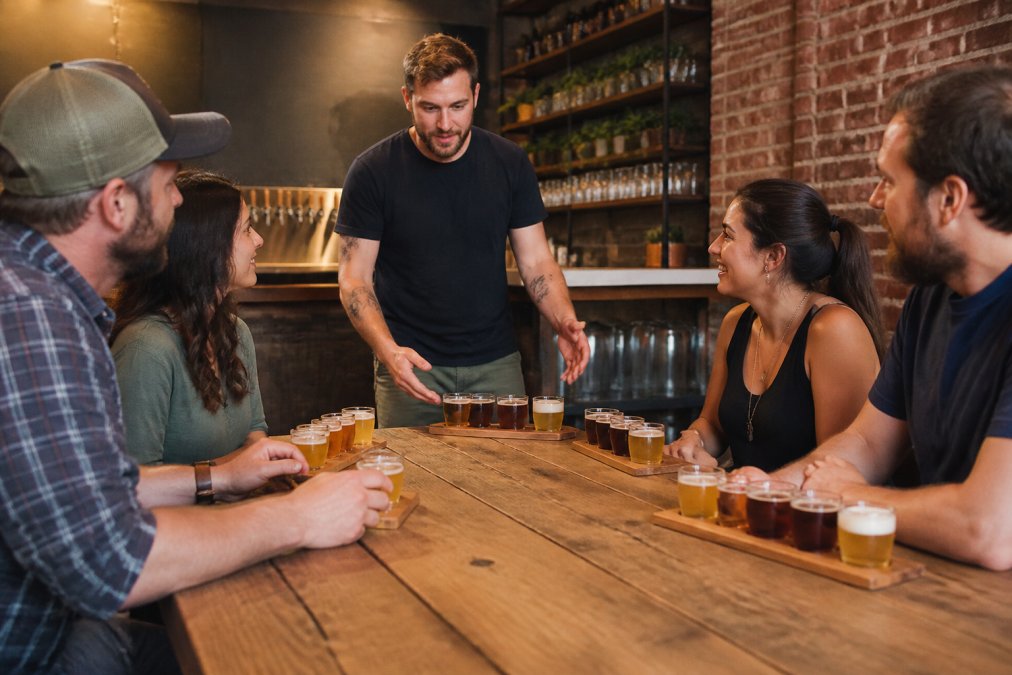
Most guided tastings follow a similar shape: you arrive, the host introduces the brewery or theme, then comes the flight, typically four to six small glasses arranged from lightest to darkest or lowest to highest ABV.
The session usually moves through three phases:
- Introduction and pouring (10-15 minutes). The host explains what you are drinking and in what order.
- Guided tasting (30-45 minutes). You work through each beer with prompts on aroma, carbonation, and malt character.
- Open discussion (15-30 minutes). Questions, refills, and general conversation.
A common mistake is treating the tasting as a race. The beers are small so you linger on each one.
Ask the host what order to drink in before you start. Going from a heavy stout back to a pale ale will flatten the hops profile of everything that follows, and you will miss the point of the flight entirely.
Craft Beer Tasting Experience Benefits: What You Actually Gain
The main benefit of a craft beer tasting experience is calibration: you learn what you actually like, not what you think you should like, by tasting styles side by side under guidance. That shift changes how you order beer for years.
Beyond that, there are concrete gains:
- Sensory skills. You start noticing aroma and mouthfeel instead of just “hoppy” or “not hoppy.”
- Vocabulary. Terms like malt character, attenuation, and hop profile stop being noise and start being useful.
- Brewery tour context. If the session includes a walk-through, you see how fermentation and conditioning shape the final flavour.
- Social activity. A flight is one of the few formats where a group can talk about what is in front of them without it feeling forced.
The educational value depends heavily on the host. A guide who can explain why a beer tastes of grapefruit rather than pine is worth more than an extra two samples.
Campaign for Real Ale guidance on beer styles and tasting
Best Craft Beer Styles for Beginners
For anyone new to craft beer, the best starting styles are pale ale, amber ale, and a light lager or pilsner. They cover a wide range of flavour without overwhelming the palate, and appear in most beginner-friendly flights.
What most beginner guides skip is why these styles behave the way they do. Once you understand the mechanism behind each, you can predict what you will taste before you sip, turning a flight from a novelty into a skill.
The Beginner Flight, With the Mechanics Behind Each Style
- Pale ale. The benchmark for judging bitterness. Bitterness comes from hops added early in the boil, where heat isomerises the alpha acids; aroma comes from late or dry hops, where volatile oils survive (peer-reviewed research). A well-made pale ale shows both sides in one glass.
- Amber or red ale. More malt character and a touch of sweetness. Colour and body come from specialty crystal or caramel malts, stewed during malting so their sugars caramelise. This style teaches you what “body” means.
- Pilsner or lager. Clean and crisp, useful for understanding carbonation. Lagers ferment cold with bottom-fermenting yeast, suppressing fruity esters so malt and hops speak plainly. A muddy pilsner usually signals poor fermentation temperature control, not the recipe.
- Stout or porter. Roasty and rich. Coffee and chocolate notes come from roasted barley and black malt, grains kilned at high temperature until they darken. A good test of whether you enjoy darker malt flavours.
- IPA. High hop profile, often high ABV. Best saved for later in a session because the bitterness accumulates on the palate and will flatten anything lighter that follows.
How to Read a Beer Flight Like a Beer Judge
Judges assess beer on four axes: aroma, appearance, flavour, and mouthfeel. You can use the same framework without training. Start with aroma before you sip, swirl gently and note citrus, bread, coffee, grass. Then check colour and clarity. Finally taste, and note the finish that lingers after you swallow.
Write one word per beer on your phone or a tasting mat: “grapefruit,” “toast,” “flat,” “sharp.” Those single words tell you more about your preferences than any score out of ten.
The Beginner’s Order of Play
If you are building your own flight at a taproom, order them like this:
- Lager or pilsner first. Cleanest palate, lowest bitterness, sets a baseline.
- Pale ale second. Introduces hop bitterness without overwhelming.
- Amber or red third. Malt sweetness resets the palate after the hops.
- IPA fourth. The bitterness peak, everything after this will taste sweeter by contrast.
- Stout or porter last. Roasted malt and higher body close the session.
This order is not arbitrary: bitterness and roast accumulate on the palate, so putting them last preserves your ability to taste the lighter beers. Reverse it and a pilsner tastes like water.
If a flight arrives in the wrong order, do not be afraid to rearrange the glasses yourself. A good host will not mind, and a bad host has just told you something useful about the session.
The point of a flight is comparison, not consumption. Four beers tasted side by side will teach you more than six beers drunk in sequence.
How to Judge Whether a Tasting Is Worth the Money
A tasting is worth the money when the cost per person is roughly what you would spend on the same number of full measures at the bar, and you get guidance, context, or a setting you could not replicate alone. If the price is significantly higher than the beer alone, you are paying for the experience, which can still be good value, but know what you are buying.
“Value” is not one number, it is a bundle of four things, and you need to know which ones you are paying for.
What You Are Really Paying For
Every tasting price breaks down into four components:
- The beer itself. Four to six small measures. At typical taproom prices, this is rarely more than a third of the ticket.
- The host’s time and knowledge. A trained host who can explain brewing processes, answer questions, and adapt to the group is the single biggest driver of whether a session feels worth it.
- The setting. Reserved space, proper glassware, a room that is not competing with a football screen. This is real overhead for the venue.
- Logistics and service. Booking, dietary handling, table service, and the fact that nobody has to wash up.
When a tasting feels overpriced, one of these four is missing, usually the host. A script-reader in a noisy corner is a beer-only experience at an experience-only price.
Cost-Benefit by Budget
| Budget Level | Best Option | What You Get | What You Give Up |
|---|---|---|---|
| Tight | Home tasting with shop-bought bottles | Full control, lowest cost per head | No host, no context, you do the research |
| Moderate | Self-guided flight at a taproom | Good beer, some guidance, flexible timing | No structured education, no reserved space |
| Comfortable | Guided tasting with food pairing | Education plus occasion, matched dishes | Higher cost, fixed timing |
| Group occasion | Private hosted session | Logistics handled, space reserved, host dedicated to your group | Highest per-head cost, minimum numbers usually apply |
The Per-Head Maths That Actually Matters
A useful rule of thumb: compare the tasting price against the same number of measures at the bar, then ask what the difference buys you.
- If the difference is small and a host is present, it is almost always worth it.
- If the difference is small and there is no host, you are paying bar prices for smaller pours, fine for a social, poor for learning.
- If the difference is large, the host and the setting have to carry it. A genuinely knowledgeable guide can. A script cannot.
For a group booking, the value calculation shifts. A private session for a birthday or work social often works out better per head than individual flights, because the venue can plan around you, reserved space, timed pours, and food that arrives on schedule.
The Questions That Reveal the Real Value
Run through this checklist before you book:
- How many beers are included, and what size are the measures?
- Is there a host or guide, or is it self-guided?
- Does the price include food, or is that separate?
- Is the venue accessible, and is there parking or public transport nearby?
- What is the cancellation policy if plans change?
If a venue cannot answer the first two clearly, the value question is already answered for you.
Pricing varies widely by venue, number of beers, and whether food is included. Pricing varies widely by venue, number of beers, and whether food is included. Get in touch directly for a current quote.
| What You Are Paying For | Worth It When | Not Worth It When |
|---|---|---|
| Guided expertise | Host can explain styles and answer questions | Guide reads from a script |
| Curated selection | Beers are chosen to build on each other | Random assortment with no order |
| Setting and atmosphere | Venue adds to the occasion | Cramped, noisy, or rushed |
| Food pairing | Dishes are matched to specific beers | Generic snacks, no pairing logic |
| Group experience | Space is reserved and comfortable | You are squeezed into a corner |
A tasting is worth it when the price difference over bar prices buys you a host who knows their subject and a room that lets you hear them. Everything else is decoration.
Red Flags to Avoid When Booking a Tasting Session
The clearest red flag is a tasting with no stated number of beers, no measure sizes, and no indication of whether a guide is present. Vague on all three means you are booking blind.
Other warning signs:
- No information on accessibility. If you or someone in your group has mobility needs, a venue that cannot answer basic questions about step-free access is a problem.
- No dietary options mentioned. A tasting that involves food should be able to tell you what happens if someone is vegan or has an allergy.
- Overbooked sessions. If the venue will not tell you the maximum group size, assume it is too large.
- No cancellation terms. Life happens. A venue with no policy at all is a venue that has not thought about customers.
- Pressure to pre-pay for large groups without a conversation. A good venue will want to talk through numbers first.
A tasting advertised only by price, with no detail on what is included, is the single most common source of disappointment. You will not know whether you are getting four small samples or six generous ones until you sit down.
Food Standards Agency guidance on allergen information for food businesses
Home Tasting vs Professional Tour: Which Suits You?
A professional tour suits you if you want context, a host, and a setting that feels like an occasion. A home tasting suits you if you want control over beers, pace, and cost, and are happy to do the research yourself.
Here is the honest split:
Choose a professional tasting if:
- You want to learn from someone who knows the brewing process
- You are organising a group and want the logistics handled
- You want access to beers you cannot easily buy in shops
- You value atmosphere and service as part of the experience
Choose a home tasting if:
- You have a specific list of beers you want to try
- You want to control portion sizes and pace
- Budget is the primary concern
- You prefer a quieter setting
Cost-benefit by budget:
| Budget Level | Best Option | Why |
|---|---|---|
| Tight | Home tasting with shop-bought bottles | Full control, lowest cost per head |
| Moderate | Self-guided flight at a taproom | Good beer, some guidance, flexible |
| Comfortable | Guided tasting with food pairing | Education plus occasion |
| Group occasion | Private hosted session | Logistics handled, space reserved |
For groups of six to 130, a hosted session at a venue with proper space tends to beat a home setup on enjoyment, even at higher cost. The room, service, and lack of washing up are part of what you are buying.
At Plonkers Wine Bar, our specialist beer selection is built around local breweries and independent drinks makers, and we host regular live music and open mic nights alongside. For a group celebration, that combination of a riverside setting, home-cooked food, and a proper beer list is hard to assemble at home.
Deciding whether a local craft beer tasting is worth it comes down to matching the format to the occasion. For education, book a guided session with a host who knows the brewing process. For a social evening with good beer and no washing up, book a table somewhere that takes its beer list seriously.
At Plonkers Wine Bar, we have been family owned and run since the early 1980s, completely independent and untied to any supplier. Our specialist beer selection, locally sourced food, and riverside setting make us a natural fit for tastings, group celebrations, and relaxed evenings. Get started with Plonkers Wine Bar and book your table for a proper local beer experience.
Frequently Asked Questions
Is craft beer worth the extra cost compared to standard lagers?
It depends on what you value. A craft beer tasting typically costs more per pour than a standard lager, but you are paying for smaller-batch brewing, a wider range of beer styles, and the chance to try several beers side by side. If you want to build sensory skills, understand hops profile and malt character, and find a local brewery you will return to, the cost per insight is often lower than buying full pints blind.
Are brewery tours and tastings suitable for beginners?
Yes. Most guided tastings are built for people with no prior beer education. A good host will explain the brewing process in plain terms, talk you through aroma, mouthfeel and carbonation, and let you taste at your own pace. If you are new to ale, start with a curated selection of lighter beer styles rather than a heavy stout, and say so when booking so the taproom can adjust the flight.
How do I choose the best craft beer tasting experience?
Check three things: group size, whether the host is a trained beer judge or experienced brewer, and whether the flight is a curated selection matched to your taste. Ask how long the tasting session runs, what beer styles are included, and whether food pairing is offered. A session that explains tasting notes as you drink teaches more than one that simply pours five beers and leaves you to it.
What are the benefits of supporting local independent breweries?
Independent breweries keep money in the local economy, brew in smaller batches that allow more experimental beer styles, and often host taproom events that build a social activity around beer culture. Tasting at the source lets you ask about the fermentation process and the hops profile directly, which is hard to do through a supermarket shelf. Many venues also pair their beers with locally sourced food, so one visit supports several local suppliers.