
Last Updated: November 6, 2026
Quick Summary
Restaurants reheat leftovers by heating every portion until the centre reaches 75°C, checked with a food probe, and then serving it immediately. Leftovers should be reheated only once, because each cooling and reheating cycle gives bacteria another chance to grow.
- The widely used target is 75°C at the centre of the food, per Food Standards Agency guidance.
- Probe the thickest part of the food, away from the edges and the bottom of the pan.
- Stir or turn the food to remove cold spots before taking the reading.
- Label each container with cook, cool and reheat dates so the one-reheat rule is visible.
- Hot holding keeps food warm for service but does not replace proper reheating.
Table of Contents
- Safe Reheating Temperature for Food in a Commercial Kitchen
- Cooling Food Safely in a Restaurant Before It Is Stored
- How Many Times Can You Reheat Food Under UK Food Safety Rules
- Using a Food Temperature Probe for Restaurants to Verify Heating
- Reheating Methods: Microwave, Oven, Stovetop and Hot Holding
- Training Staff and Keeping Records for Reheated Leftovers
- Setting Up Your Own Leftover Reheating Checklist
- Frequently Asked Questions
A reheat that looks fine on the plate can still leave bacteria alive in the middle of the dish. That is why restaurants treat reheating leftovers as a controlled process, not a quick job at the pass.
Reheating matters because it is often the last chance to kill harmful bacteria before a dish reaches a guest. Food that has been cooled, stored and reheated again carries more risk each time it is handled. A fixed procedure keeps that risk low and makes sure every member of staff does the same thing.
Most problems come from shortcuts. A dish is warmed unevenly, a probe is skipped, or a portion is reheated twice without anyone noting it. Each small gap in how staff reheat leftovers can add up to a food safety failure.
- Heat every portion to the same safe temperature
- Check the centre of the food, not just the edges
- Record what was reheated, when, and by whom
- Never reheat the same portion more than once
Watch out: the outside of a dish can look hot while the middle stays cold. Stir or turn the food and check more than one spot.
Safe Reheating Temperature for Food in a Commercial Kitchen
A safe reheating temperature is the heat level food must reach throughout before it is served. The widely used target is 75°C at the centre of the food, a standard the Food Standards Agency (FSA) explains in its guidance for food businesses. Food Standards Agency guidance on reheating food
Holding food at a warm temperature is not the same as reheating it. Reheating must bring food up to the safe level quickly, and only then should it be kept hot for service. Staff should never assume a dish is hot enough based on how it looks or smells.
Checking each batch with a calibrated food thermometer and noting the reading gives proof that the food reached the right temperature, not just a guess.
Cooling Food Safely in a Restaurant Before It Is Stored
Cooling is the first step in keeping leftovers safe, and it has to happen fast. Food should move through the danger zone, the range where bacteria multiply quickly, in as short a time as possible.
Split large quantities into shallow containers so the heat escapes quickly. Deep pans of hot food cool too slowly and stay warm in the middle for too long. Once cooled, cover, label and refrigerate the food promptly.
Labelling matters as much as cooling. Each container should show what the food is, when it was cooked and when it must be used or thrown away. Without clear labels, leftovers get reheated past their safe window.
How Many Times Can You Reheat Food Under UK Food Safety Rules
The short answer is that food should be reheated only once. Each cooling and reheating cycle gives bacteria another chance to grow, and repeated reheating weakens the safety margin.
In a restaurant, the practical difficulty is not knowing the rule but proving you have followed it. A portion of sauce made on Monday, cooled, reheated on Tuesday and then cooled again has already used its one cycle. If it appears again on Wednesday, it must be discarded, not reheated a second time. The same applies to a batch of rice, a tray of roasted vegetables or a pan of stew.
The reliable way to enforce a one-reheat rule is to make the cycle visible on the container. A simple label that records the cook date, the cool date and the reheat date gives any member of staff an instant answer. If the reheat date is already filled in, the food should not be reheated again.
Portion planning is the other half of the control. Reheating once is easier when leftovers are decanted into service-sized batches rather than stored in the original deep pan.
Watch out: a portion that has been reheated and then held hot for several hours has still only been reheated once, but it should not be cooled and reheated again the next day. The hot-holding period does not reset the cycle.
Keep a note of how many times a portion has been through the cooling and reheating process. If the answer is more than once, the safe choice is to discard it.
Using a Food Temperature Probe for Restaurants to Verify Heating
A food temperature probe is the simplest way to prove that reheated food is safe. Insert the probe into the thickest part of the food, away from the edges and the bottom of the pan.
Wait until the reading is steady before you record it. A probe pushed into a cold pocket can show a false low, so move it to a second spot if the number seems off.
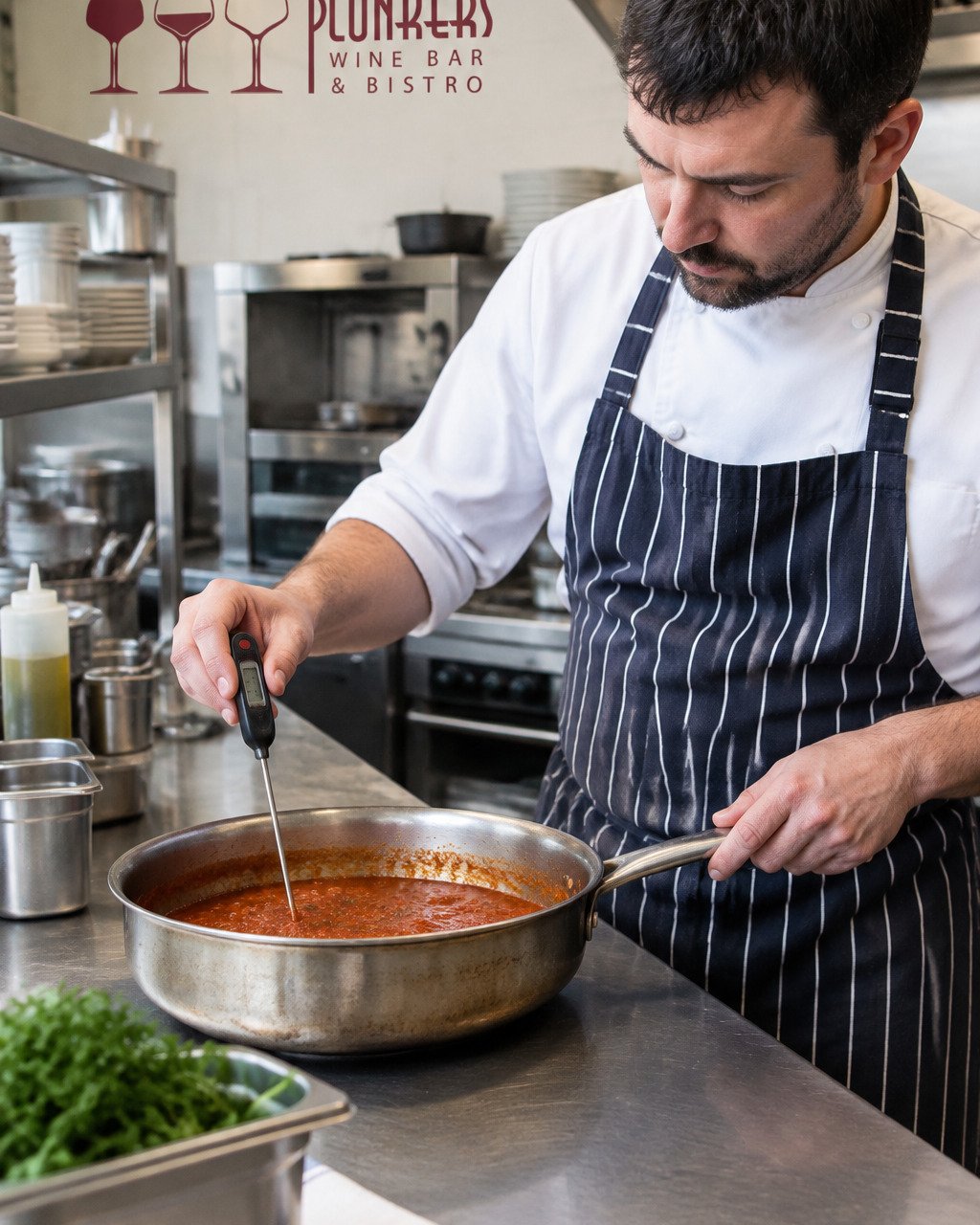
Calibrate your probe regularly against a known reference, such as ice water, so the readings stay reliable. A probe that reads two or three degrees out can hide a real risk.
Reheating Methods: Microwave, Oven, Stovetop and Hot Holding
Each reheating method has strengths and weaknesses, and the right choice depends on the food, the batch size and the equipment available at the pass. The table below sets out how a restaurant kitchen typically matches method to food type, with the check that confirms even heating. Mastering these professional techniques ensures that the integrity of complex dishes remains intact, a principle that also applies when reheating artisan meals in a domestic kitchen.
| Food type | Preferred method | Key check |
|---|---|---|
| Soups and sauces | Stovetop, stirred constantly | Probe the centre and the base of the pan; stir before reading |
| Rice and grains | Microwave or stovetop with a splash of water | Break up clumps and probe two spots; rice heats unevenly when compacted |
| Roasted meats and poultry | Oven, covered, or microwave for single portions | Probe the thickest part away from bone; check a second location |
| Seafood | Gentle stovetop or microwave on reduced power | Avoid overcooking; probe the thickest piece and serve immediately |
| Dense dishes (stews, curries, pies) | Oven or stovetop, stirred | Probe the centre and the edge; dense food holds cold pockets |
| Plated portions | Microwave | Stir or turn, allow to stand, then probe before service |
Microwave: fast, but heats unevenly. Stir halfway through, allow the food to stand for the full standing time, and probe before service. Microwave ovens vary in power, so a time that works on one unit may underheat on another; check the reading rather than trusting the timer.
Oven: good for larger portions and roasted dishes, but slower to reach temperature. Covering the food helps it heat through without drying, and a probe reading from the centre of the thickest item is the only reliable confirmation. Ovens are less suitable for single portions because the outside can dry before the centre reaches temperature.
Stovetop: ideal for soups, sauces and pasta. Stir constantly to avoid cold spots, and remember that a thick sauce can bubble at the edge while the centre stays below the safe level. Probe after stirring, not before.
Hot holding: keeps already-safe food warm for service. It does not replace proper reheating. A common mistake is using hot holding to warm cold leftovers; hot holding is designed to keep food hot, not to bring it up to a safe temperature. Reheating must bring food to the safe level quickly, and only then should it be transferred to hot holding.
Watch out: a microwave that has been used continuously through service can lose power output, and an oven opened repeatedly will drop temperature. Probe the food, not the equipment setting, and recheck if the unit has been in heavy use.
Training Staff and Keeping Records for Reheated Leftovers
A procedure only works if every member of staff follows it. Train new starters on the reheating steps, the probe check and the labelling system before they work a service alone.
Keep simple records. A daily log showing the item, the time it was reheated, the final temperature and the initials of the person who checked it gives you a clear audit trail.
Setting Up Your Own Leftover Reheating Checklist
A written checklist turns the procedure into something staff can follow at a busy pass. Keep it short, clear and visible in the kitchen.
- Label every container with the item and date
- Cool food quickly in shallow containers
- Refrigerate promptly once cool
- Reheat only once and note the batch
- Probe the centre and confirm it reaches 75°C
- Stir or turn the food to remove cold spots
- Record the reading and your initials
A checklist like this is often easier to keep up than a long manual.
Frequently Asked Questions
How many times can a restaurant safely reheat food?
UK food safety guidance advises that food should be reheated only once. Each time food cools and is reheated, the risk of bacterial growth increases, and food that has been reheated more than once should be discarded. Restaurants should plan batch sizes so that leftovers are used or thrown away rather than repeatedly cooled and reheated. Keeping a clear record of when food was first cooked and cooled helps staff avoid reheating it again.
What temperature should reheated food reach in a restaurant?
Food should be reheated until it reaches a core temperature of at least 75°C, and it should be steaming hot throughout. Using a calibrated food temperature probe is the most reliable way to confirm this, as surface temperature can be misleading. Liquids such as soups and sauces should be brought to a rolling boil. Food should be reheated quickly, ideally within two hours, and kept above 63°C if it is being held rather than served immediately.
How quickly should cooked food be cooled before refrigeration?
Cooked food should be cooled as quickly as possible, moving from 63°C to 8°C within 90 minutes, and it should be placed in the fridge within 90 minutes of cooking where practical. Dividing large quantities into shallow containers, placing them in ice baths and avoiding stacking hot trays speeds cooling. Labelling each container with the date and time of cooking supports traceability and helps staff use stock in the right order.
Which foods should not be reheated in a restaurant?
Rice, particularly cooked rice left at room temperature, carries a risk of Bacillus cereus and should be cooled quickly and reheated only once. Some foods, such as cooked egg dishes and shellfish, are more prone to quality loss and should be prepared in smaller batches. Any food that has been left out of temperature control for too long, or whose storage history is unclear, should be discarded rather than reheated.
